When I set out to interview all of the folks that were doing work that I respected back in the ‘90s, during the golden age of zines, there was one person I knew I wouldn’t be able to speak with. I’d been told by multiple people that Doug Holland, the man behind the legendary zine Pathetic Life, had disappeared completely. I was told that, even if I could find him, there was no way he’d ever talk with me about his life, and the circumstances which led up to the publication of what would go down in history as the “personal zine” against which all others would be measured. I saw a faint glimmer of hope when I’d heard, a month or so ago, that he’d started writing again at ItsDougHolland.com, and reposting the occasional story from Pathetic Life, but I didn’t get my hopes up. Then, a few days ago, I saw that he’d left a comment on my website, in response to another zine-related interview that I’d done, and I reached out. And, surprisingly, the man who entertained us all those years, writing so openly about his masturbation and canker sores, frustrations and loneliness, said that he’d be up for talking… He actually said that he wouldn’t do an interview, as he’d only done a few in his life, and hated every one of them, but that he’d be up for a “chat”. Well, here’s that chat. I hope you enjoy it.
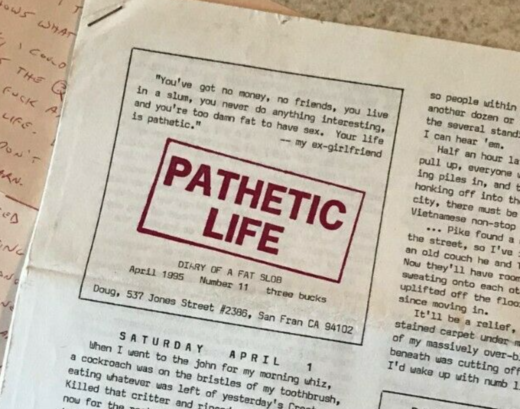
[above: The cover of Pathetic Life: Diary of a Fat Slob #11, April 1995.]
MARK: How do I know I’m talking with the real Doug Holland? Can you tell me something only the real Doug Holland would know?
DOUG: Well, you got me. There is no ‘real’ Doug Holland. It’s a pen name. Actually I’m Banksy.
MARK: I’m sorry, but I had to ask. I don’t want to be made a fool of like David Letterman, that time Dishwasher Pete tricked him into interviewing his friend.
DOUG: I respect the suspicion, Mark, if that’s who you really are. I love what Dishy Pete did, but I am who I am.
MARK: Speaking of Pete, I know that you were fond of his zine, but I’m curious as to what else you were reading back in the day, when you were putting out Pathetic Life?
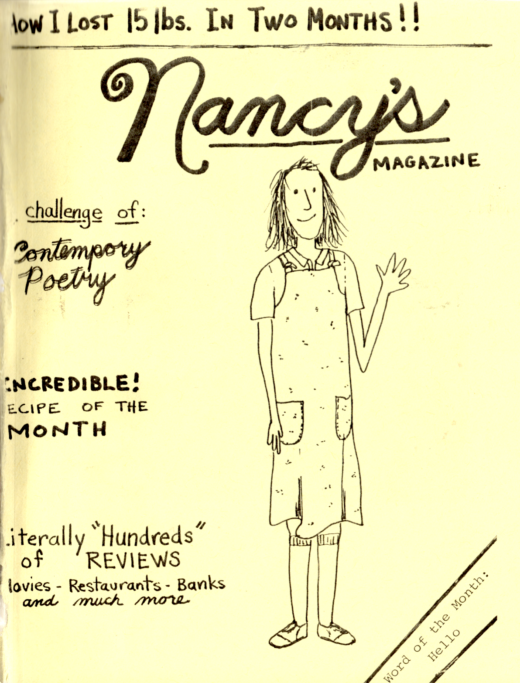
DOUG: I remember something pretty good called Crimewave USA. And in alphabetical order, because I’m anal: Black Sheets. Cometbus. The Connection. Crank. Crawfish. Derogatory Reference. Dishwasher. Duplex Planet. Factsheet Five. Gulp Life. Living Free. Lookout. Maximum Rock’n’Roll. The Match. Murder Can Be Fun. Nancy’s Magazine. Pasty. Queer Zine Explosion. Temp Slave. There’s Something About A Train. Twenty Bus. My apologies to any of the greats I’ve forgotten, but it was a long time ago, and dementia sneaks up on ya.
The internet has its appeal and I love that, too, but there was nothing like zines in the ‘90s. It was a festival of freaks, and I loved all of it, even the zines I didn’t love. It’s hard to even convey the wonder of it — all these people writing up their lives or their fixations, whatever was consuming their brains and souls.
Usually, zines were about something I didn’t give a damn about, like coin collecting or hula hooping or housebreaking a puppy, but what a zine was about barely mattered. The allure was that all these people were pounding their hearts out, putting it on paper, mailing it to anyone interested enough to ask for a copy and send a few dollars. A golden era, it was.
MARK: You mentioned my old zine, Crimewave, and I’m 90% sure that you’re just being kind, which I appreciate. It’s very kind of you. On the off chance that you meant it, though, I’m curious as to whether or not you have any memories of it, or of me. As I recall, we did correspond a bit. If I can get up the motivation, I’ll go into the basement and dig through my musty, old boxes to see what I can find of our correspondences.
DOUG: I don’t remember corresponding with you, sorry, and hope I wasn’t an arrogant prick. I do fondly remember Crimewave USA, though, and that’s not a kindness. I don’t do ‘kindness’ much.
MARK: It’s been a long time, and I may have the facts a bit off, but I think, for the most part, there were just brief notes back and forth, usually along the lines of, “I like Crimewave alright, but I hope you’re not looking for a trade. I just want your cash.” Does that sound like something that you might have written?
DOUG: Sounds like something a prick would’ve written, so it must’ve been me. In my defense, though, there were years when I was barely scraping by, and every dollar could buy two dented cans of beans.
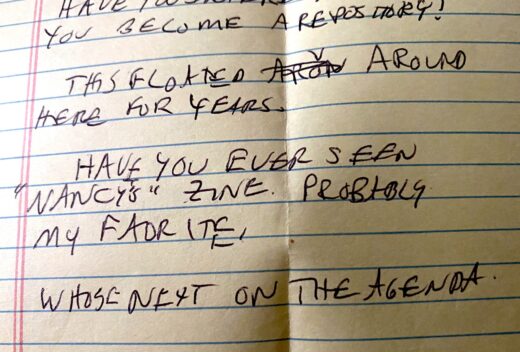
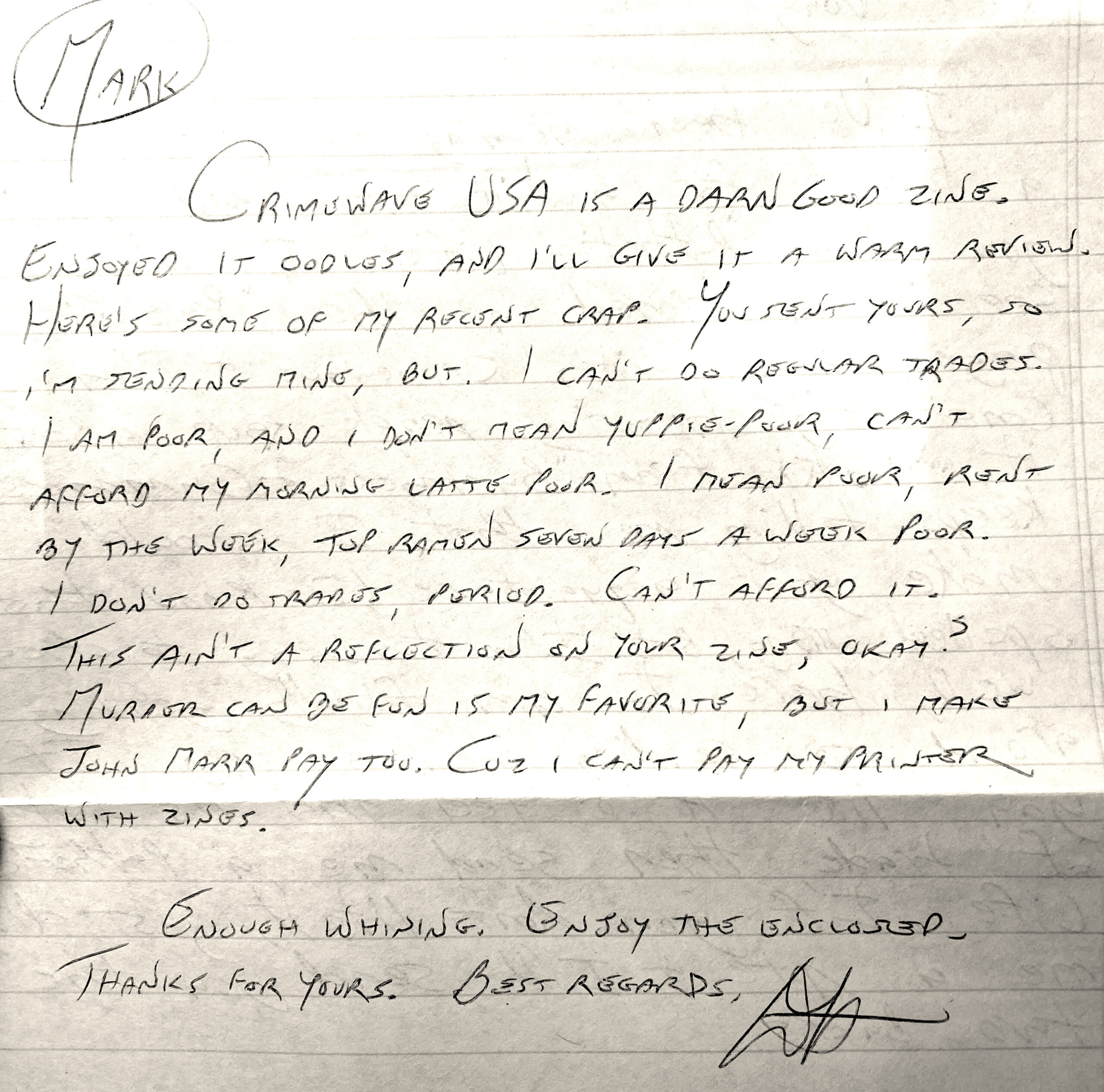
MARK: Well, I forced myself to go down into the basement and dig through some files. I had the gist of that one exchange right. You did tell me that you didn’t want to trade with me, but you were really nice about it. And you didn’t say anything like, “I just want your money,” but I guess that was the subtext. Also, I figured out the context around my writing to you in the first place. (Your letter to me was written on the back of my letter to you.) I’d been trading zines for a while with Loki Quinnangelis, the woman behind the zine Bummers and Gummers, and she suggested that I send you a copy of Crimewave and introduce myself. Here’s your response, which wasn’t at all dickish. And you even sent me a copy of Pathetic Life — for free!
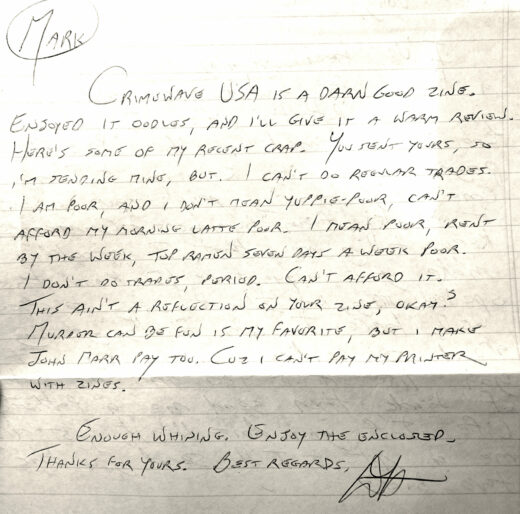
[above: Letter sent from Doug Holland in the mid ‘90s. Larger version available here.]
DOUG: That note is only moderately dickish, I guess.
MARK: So you were saying before that you do remember Crimewave?
DOUG: I especially remember a tour of Hollywood death spots. That was you, right? (Jeez, I’ll be embarrassed if that was some other zine.)
MARK: Nope, that was me, and my friend Jeff Kay, the publisher of the West Virginia Surf Report. We were both living in LA at the time, and thought it was a great idea to drive around for the day, visiting places where famous people had been found dead over the years. We had a lot of fun at the older death spots. I remember, for instance, having a good time making jokes outside the apartment building where silent movie actress Marie Prevost was consumed by her pet dachshund. But things took a turn. By the time we got to the apartment where Rebecca Schaeffer, the young star of the sitcom My Sister Sam, had been killed by a deranged fan just a few years earlier, the whole thing had become unbearably sad.
DOUG: Your website’s “shop” page says absolutely everything is out of stock, and I respect the hardcore anti-capitalism, but I would love a copy of that. Is it online anywhere?
MARK: We had a Crimewave site for a few years, but we eventually let it go. We had to make space in our lives to focus on other things. Plus, I hated filling orders. It would require me climbing up and down stairs, making my way through cobwebs, confronting the disorder of my basement (and my life), and digging through old boxes.
DOUG: Well, no hurry and no obligation, but someday when you’re in the basement and feeling extra energetic, I’d be willing to pay, plus postage and handling.
MARK: Now it’s my turn to say it… “I just want your cash.”
DOUG: Sounds like something a prick would say.
MARK: Speaking of money, and the financial end of things… Like you, I started out printing my zine at work. I had a job at Kinko’s, and I was friendly with the night crew, who were happy to help me out. At some point, however, as things grew, I had to find a real printer, and started paying real money to have things put out. I’m assuming that you had to start paying for the printing of Pathetic Life at some point, right?
DOUG: Yep, where I worked had easy photocopier access, but after I quit the bastards wouldn’t let me come in just to use the copier.
MARK: How many issues did you get out for free before you had to start paying?
DOUG: Nine or ten?
MARK: Did you ever come close to getting caught at work?
DOUG: Oh, sure. No good stories about that, though. I’d sneak in late at night when the office was closed, or come in early before they unlocked, so usually I was unseen. The security guards and janitors knew me as “workaholic Doug.” Once a senior executive came in hours early, and sighed, waiting while I stood at the best copier and the zine kept printing and printing. She didn’t say anything, though.
MARK: She was probably waiting to run copies of her zine, Pathetic Business Woman.
DOUG: Seven seconds of laughter after reading that. And maybe it’s true. She seemed like a very boring executive type, but there’s no knowing what’s in someone’s mind.
MARK: How were you at running the business side of things at Pathetic Life, as circulation grew, and you had to start paying for things like printing?
DOUG: Shitty. If someone pre-paid for the next four issues, I’d write it down in my messy notes, but the money went for that night’s mac ‘n cheese, or Burger King.
MARK: Did you ever contemplate selling ads, or would you have seen that selling out, being too comercial, etc?
DOUG: In Pathetic Life, nah — those pages were mine. In Zine World, sure — the whole concept was connecting people and zines, so we took ads.
MARK: Still on the subject of money, I’m curious as to whether or not you got fucked by the likes of Desert Moon and See Hear, like me and so many others. Do you have any distribution horror stories that you’d like to share, either from the Pathetic Life era, or with regard to Zine World, the zine review magazine you put out after Pathetic Life?
DOUG: The big distributors’ orders for Pathetic Life were small, so I was only out the cost of twenty or fifty copies. I had better luck selling directly to a few honest stores, like Quimby’s and Powell’s and a few others.
I also worked for a much bigger and more successful zine/magazine, Black Sheets, and my recollection is that Desert Moon cost them many hundreds, maybe thousands of dollars, and came close to taking them down.
In retrospect, Desert Moon was structured for fraud. Send us your stuff now, and we’ll pay you in 90 days… or six months… or never, if we fuckin’ feel like it… but we might mail the covers back to you. It was the perfect pre-Nigerian Prince scam.
MARK: I’d forgotten that you worked for Black Sheets. What was that experience like?
DOUG: Bill Brent ran it, and he was a mensch. I had a man-crush on his sidekick, Steve Omlid. Nothing but happy memories there, of the people, the party house, and of course the orgies.
MARK: Running a zine was hard enough. I can’t imagine running one that required me to also officiate orgies?
DOUG: I didn’t do much officiating at the orgies, but I like the mental image of me in a striped shirt whistling fouls.
MARK: What did you do for Black Sheets? Did you have a column? Or were you just brought in for the orgies?
DOUG: Office work, order fulfilment, proofing and editing, clean-up after the orgies, and I worked the check-in table on party nights. I may have written an article or two for them, but never a column. Black Sheets was all about sex, and I didn’t know much about sex. Still don’t.
MARK: Did you get the job at Black Sheets as a result of putting out Pathetic Life?
DOUG: Yup. While I was out of work and in my “I’ll do anything legal for $5 an hour” phase, Bill sent for a copy of Pathetic Life. He liked the zine, and lived three blocks from me, praise San Francisco, so he invited me over for tea and crumpets, or whatnot. When he decided I wasn’t insane, he offered me a job. He needed an office flunky, which is what I’ve been all my life, and the only thing I’m any good at.
MARK: How did those orgies work? I’m curious as to the business model, as I know Black Sheets hosted them to raise money, right?
DOUG: Bill was a well-known local character, and the party house was a famous San Francisco institution in certain circles, so there was always a crowd. We simply announced a date and time, and people paid to get in, and got as undressed as they wanted. We supplied the chips, soda, condoms, and lube, and the party house was well-equipped for fun and games.
MARK: Do you have fond memories of cleaning up afterward?
DOUG: Actually, yes! Most partygoers were very tidy — discarded condoms and lube wrappers were almost always in the trash bins, not littering the floor or behind the couch cushions. You definitely appreciate little things like that.
MARK: I knew very little of Black Sheets. Because of our conversation, though, I’ve been doing a little research about the magazine, and Brent, who took his own life back in 2012. He seems like a fascinating guy. What can you tell us about him?
DOUG: My mother was always worried that I’d be taken in by some pervert in San Francisco, and that was Bill — biggest perv I ever knew, and he took me in. He was one of the few reliably good guys in my life — a gifted writer, and a smart, genuinely kind guy who became a friend.
MARK: You mentioned your “I’ll do anything legal for $5 an hour” phase, during which you were advertising that you’d do anything legal for five bucks an hour, leading to all kinds of incredible stories in Pathetic Life. And I’m curious as to how much that was strictly financial, and how much was driven by the desire to create material for the zine?
DOUG: All financial. It was San Francisco — if I had nothing to write about, I could walk around the block, and there’d be something crazy. Took that walk many, many times, when nothing else was going on. Cleaning some stranger’s garage? That was for money, and most of my gigs weren’t worth writing about.
MARK: Did you ever take a job, though, because you knew it would work well in the zine? I’m thinking specifically about the job you had to shave the man’s matted, hairy ass.
DOUG: Sure, it popped into my head — Oh, that might make an interesting paragraph. The deciding factor, though, in taking any gig, was just whether it felt safe, and whether too much heavy lifting was involved. Boring was almost promised by the title, so I wasn’t looking to keep anyone entertained.
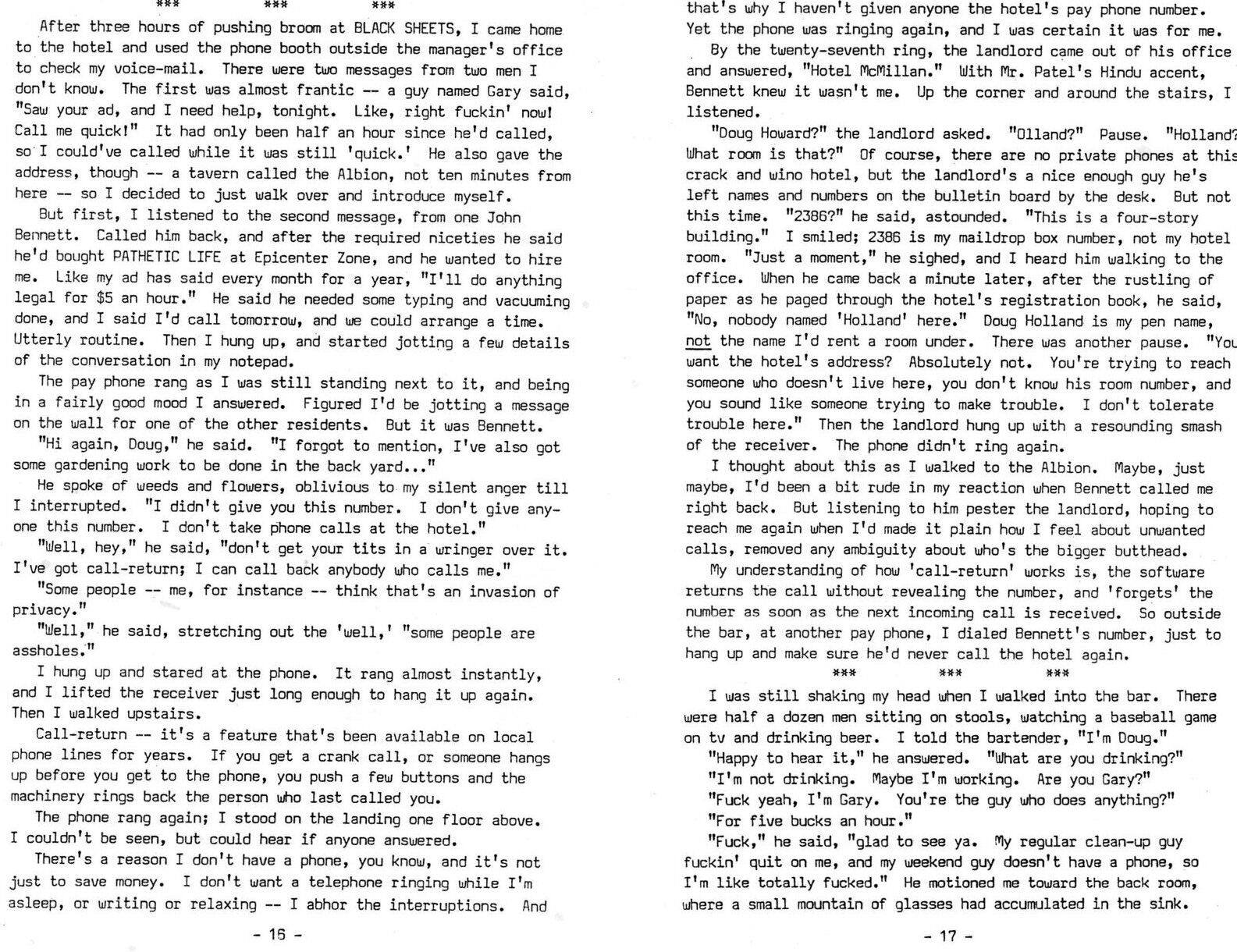
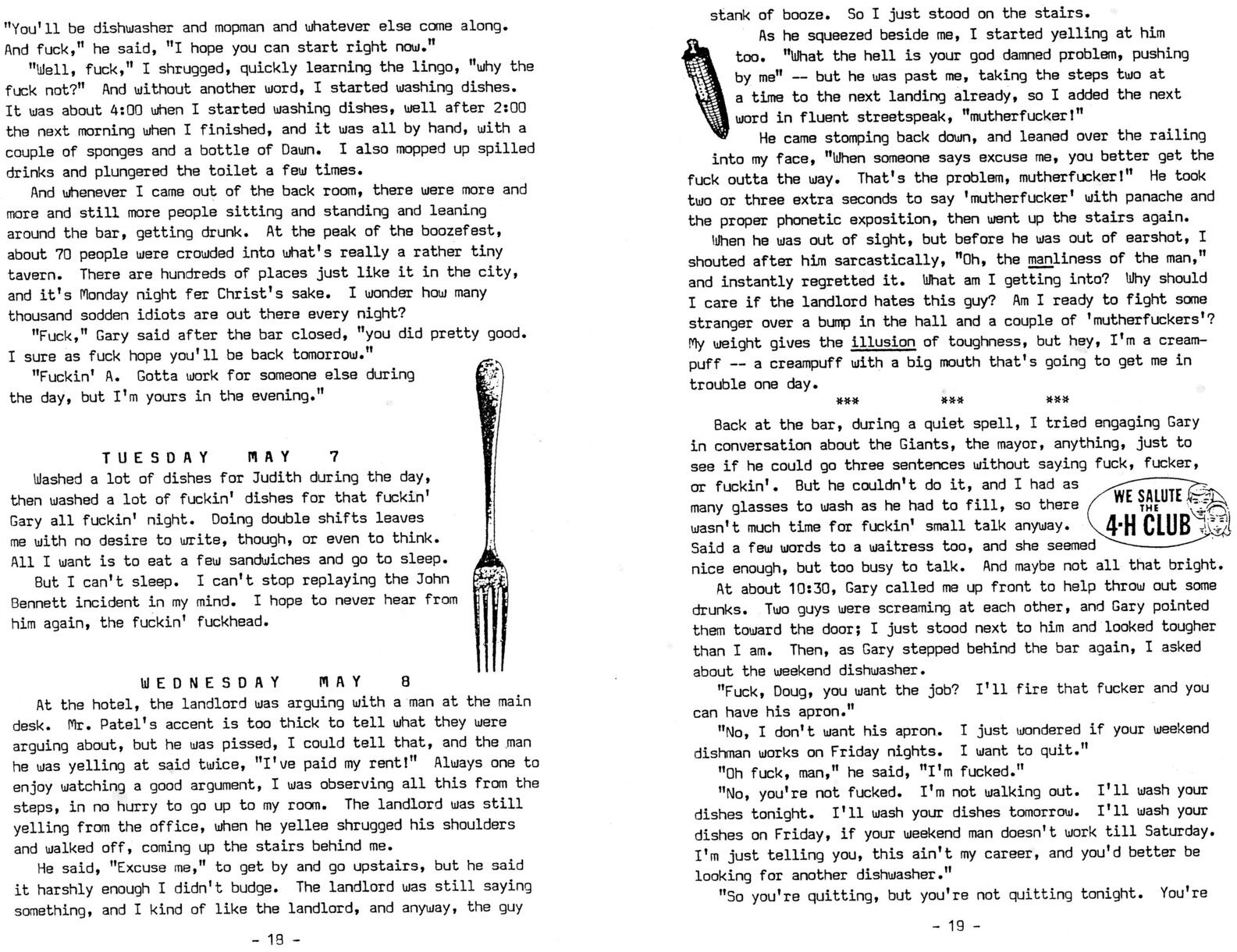
MARK: As luck would have it, our mutual friend, John Marr, of Murder Can Be Fun fame, just happened to have a copy fo Pathetic Life #10 laying around, and he sent me the following scan of the “I’ll do anything for $5 an hour” ad. Am I right to assume that the number given is the number for the public phone on your floor of the residential hotel where you lived?
DOUG: No, I never wanted phone calls at the hotel, and never had a phone. That number was a service that probably no longer exists — for $5 or $7 a month, some company would invent a phone number for you, and their machine took incoming messages. Nobody could reach me directly at that number, but I could call, hit a few buttons, listen to the messages, and call back any prospective employers who didn’t sound too shady.
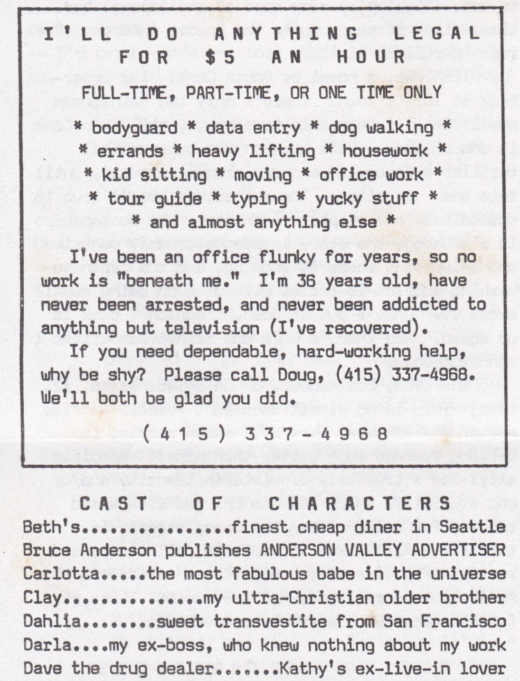
[above: Doug’s ad that ran in issue #10 of Pathetic Life.]
MARK: Did you post these ads around town, or were they just in Pathetic Life?
DOUG: I pasted those ads everywhere, and occasionally got hollered at for it, threatened with tickets, or a punch in the jaw. Telephone poles, laundromats, newspaper boxes, bus bumpers and windows, the walls of buildings — wherever people might be, my stickers might be. Toward the end they were high-quality stickers, so maybe some are still stuck.
MARK: How long did you run the ad, and what made you stop?
DOUG: I never stopped stickering San Francisco until Stephanie and I moved away, circa 2001. I tried stickering Kansas City when we got settled there, but Missouri wasn’t California, and there were literally no calls, which was the first sign that we’d moved to the wrong place. Fast forward to 2021, and my job is being outsourced soon, so maybe I’ll sticker Wisconsin. My rates, though, have gone up.
MARK: Did you ever get any work as a bodyguard?
DOUG: Does bouncer count? I pulled a few shifts at a country and western bar trying to look tough, with an understanding with my employer that if actual toughness was needed, he’d step in.
MARK: Yes, that counts… Any memories, or anything that you’d like to share about the Pathetic Life “cast of characters” that we can see listed under the ad?
DOUG: The “cast of characters” was included so new readers wouldn’t get too confused, and the list is much longer list than what’s glimpsed in that image.
Beth’s was a great breakfast place in Seattle (closed permanently just a few weeks ago). I don’t know why I mentioned Beth’s in that issue of Pathetic Life, and I’m not curious enough to re-read it tonight.
Bruce Anderson is a real person. He publishes the Anderson Valley Advertiser, a cranky opinionated small-town newspaper that I *still* subscribe to, and sometimes write for.
Carlotta? “The most fabulous babe in the universe,” it says, but that could’ve been any woman who half-smiled at me, and tonight I’m clueless who she was. It’ll come back to me when I get around to reading and re-typing that issue.
Dahlia was my invented name for one of the fairies who hung around at the party house (Black Sheets). A few of them were very kind, welcoming, accepting of the new fat straight guy, me.
Darla was my ex-boss from Macy’s, the job I’d just delightfully quit without notice.
Dave probably was *not* a drug dealer, but I know evasion when I hear it, and he’d been evasive when I’d asked what he did for a living. Just as likely he was a garbage man or something.
MARK: I was really surprised to hear from you the other day. I was under the impression that you’d dropped out for good, never to be heard from again.
DOUG: I’m a world-class quitter who’s dropped out of almost everything in my life — high school, family, friendships, relationships, jobs, God, even Zine World — but I never dropped out of zines. I’ve been reading zines for fifty years, and a dozen are scattered around this room.
MARK: I’d thought that maybe you’d moved off-grid to be a hermit somewhere, like Mike Gunderloy. (I don’t know that Gunderloy, the first publisher of Factsheet Five, is technically a hermit. I’ve just heard that he enjoys the isolation of rural farm life.)
DOUG: I was off-the-grid for a few days in the 1980s, but immediately missed my microwave oven. ‘Hermit’ seems accurate, though — I don’t get out much, and never invite anyone over.
MARK: I know, from reading your site, that you get out at least once a week to eat breakfast at a diner called Bob’s.
DOUG: That’s about it, and a daily walk around the block. Other than that, I’ve been homebound for a year and a half (thanks, COVID) and it’s idyllic.
MARK: You’ve always liked being by yourself, haven’t you? …There’s a great quote of yours from Pathetic Life explaining why you moved hundreds of miles from your family, cut off all communication with them, etc. Here it is… “I want to be alone. I like to be alone. I’ve come a great distance specifically to be alone.” I think this was said to your mother after she tracked you down in San Francisco to tell you that your father had died, and give you his underwear.
DOUG: You’ve got the timeline close enough, and yeah, those three sentences could be my epitaph.
MARK: What did you do with your dad’s underwear, and all the other stuff of his that your mother brought to you that time, by the way? Are you at all sentimental? Did you save anything of his?
DOUG: I still have the bow tie in a box somewhere. Dad wore bow ties, so it has sentimental value. I remember washing somebody’s car for $5 an hour, scrubbing hubcaps with my dad’s underwear. Everything but the bow tie was eventually lost or given to Goodwill.
MARK: Earlier, you mentioned living off-the-grid. I suspect you may have been joking — as I know how much you liked films and fast food — but I thought that I’d better ask, just in case. Did you really give life in the forest a shot?
DOUG: Normal sucks, and I’ve tried many ways to escape it, including going off-the-grid. My plan was to live in the woods like Robert Redford in Jeremiah Johnson, but I started regretting it the first night, and came back to the city within days — decided I liked the grid, gotta be on the grid. Then I lived in my van for a long while, and spent years in cheap residential hotels, and of course there was my time in Bangladesh.
MARK: OK, I’ll bite. What’s this about Bangladesh? Did I not get the last issue of Pathetic Life? Does it end with you renouncing all of your worldly possessions, and learning to play the sitar in an ashram somewhere?
DOUG: Never been to Bangladesh. I’m tipsy from drinking fermented prune juice.
MARK: How old are you, anyway?
MARK: I’m in my 60s. How old do I look?
MARK: That’s the great thing about not really existing, I guess. No one knows when you look like shit… As you mentioned the cheap residential hotel where you lived in San Francisco, I was wondering where it was located?
DOUG: I lived in several different flea & roach infested residential hotels. The one where I lived “now” (in the entries I’m currently retyping for the website) was near Union Square, in downtown San Francisco. That’s the heart of Tourist Town, and a dumb place for a bum hotel. They converted it into an upscale hostel, with exponentially higher rents. Last time I looked at the neighborhood on Google Maps, the building had been replaced by something tall, shiny, and expensive.
MARK: If someone were to put a bronze plaque outside the building where you lived at the time you started putting out Pathetic Life, what would you like for it to say?
DOUG: “Once, there was affordable housing here.”
MARK: Do you remember how much you were paying in rent at the time?
DOUG: $85 a week. Reasonable, in a city where a one-bedroom apartment rents for thousands of dollars. The rent was edging upwards of $100 a week before I moved out.
MARK: If I ever start my zine museum, I’d like to include an artifact from Pathetic Life. I’m thinking maybe it should be the sink full of dirty dishes that you used to piss into, instead of walking down the hall to use the communal toilet. I wonder if that sink still exists somewhere, and whether or not I might be able to buy it.
DOUG: All gone, my friend, but a sink full of dirty dishes should be easy to recreate.
MARK: I guess that might work, if you could send me urine.
DOUG: The pee is in the mail.
MARK: On the subject of getting terrible things in the mail, what’s the worst thing you received as a result of Pathetic Life? I was talking with Darby from Ben Is Dead once, and she said that she got sent a shit-in-a-box. The worst I ever got was a bag of Larry Farber’s back hair sent from Sweden.
DOUG: I’ve mailed shit in a box a few times, but I don’t remember receiving anything mean or disgusting, beyond Jack Chick comics. Lots of people mailed me nice things — vitamins, canned foods, soap, a dildo…
What did you do with Larry’s back hair, and also, what did you do to deserve it?
MARK: I can’t recall why I got it, or what I did with it. I know that he had his daughter shave his back once, in front of an audience. Maybe that’s something they do in Sweden. It would certainly explain why my family left there a few generations ago. [update: I talked with Larry and he reminded me that I had asked for his back hair, telling him that I was pretty sure that I could sell it through Crimewave. Apparently I tried selling vials of it, to no avail. It was also Larry, by the way, that we mailing Doug vitamins at roughly the same time.]
Speaking of family history… It occurs to me that, in my excitement, I just jumped right in and started the interview without asking any of the normal background stuff. So let’s take a step back… What can you tell us about the circumstances surrounding your birth.
DOUG: Ha ha, you’re kidding, right? The circumstances surrounding my birth? Mom put her legs in the stirrups and pushed.
MARK: I wasn’t really looking for a play-by-play from when your mother’s water broke to when you started crowning… I just meant the circumstances surrounding your birth. For instance, my dad wasn’t around when I was born. It was during the Vietnam war, and he’d been drafted into the Navy. My mom, as she tells it, was drugged unconscious, and someone — hopefully a doctor — pulled me out of her with forceps. I guess that’s how they did it in Kentucky in 1968. According to her, when they tried to hand me to her, once the effects of the drugs had worn off, she pushed me away saying, “That isn’t mine. I haven’t had my baby yet.” How’d you come into the world?
DOUG: I came into the world less dramatically than that, and there’s nothing I know about what happened except the date and place. Ordinary 1950s white married couple had a baby, and it was me. I was born early on a Sunday, and Mom attended the church service later that morning. Or so I’ve been told a thousand times.
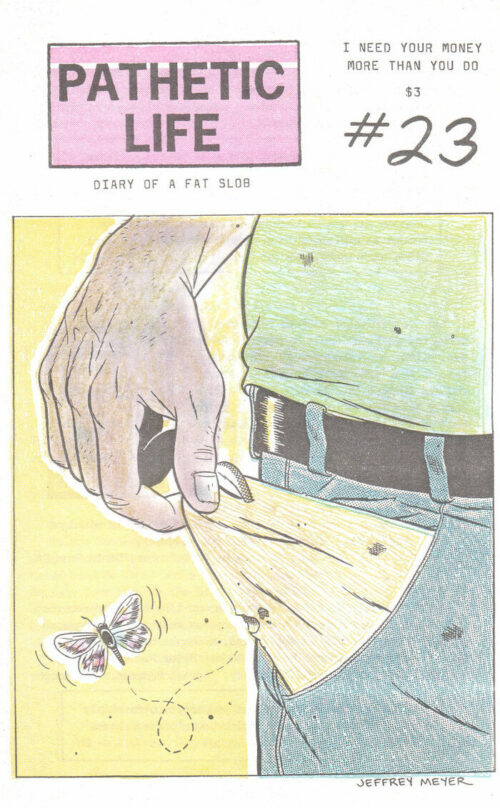
[above: The cover of Pathetic Life #23. Artwork by Jeffery Meyer.]
MARK: Would you like to talk at all about the cover art featured in Pathetic Life? I particularly liked the ones done by Jeffrey Meyer. How’d that relationship come about?
DOUG: I have a preschooler’s talent for art, meaning none, so I’m always glad when someone provides illustrations — especially since, in zineland, it’s almost always an offer without pay (same as writing gigs). I pay in thank yous, and I’m even stingy with those. Several artists created Pathetic Life or Zine World covers, and the most prolific and appreciated talent was Jeff Meyer. His cover you’ve chosen here, from issue #23, is my very favorite, capturing the essence of the zine. Jeff also did my favorite Zine World cover. All hail Sir Jeffrey.
We’re still vaguely in touch, and with a little luck he’ll eventually add some illustrations to the new website.
MARK: How’d you meet Jeff? Was he a reader of the zine?
DOUG: Yessir. And an artist. Another man at odds with our times.
MARK: While we’re on the subject of graphic design and the like, I’m curious to know about your design process, and where you got your imagery from. Did you ever use Craphound as a resource?
DOUG: Toward the end, yes, Craphound to the rescue. For the first year or so, Pathetic Life had no illustrations at all, just typing. Then came covers, but even while I knew of — and probably subscribed to — Craphound, it was a long while before it occurred to me to use it, to sprinkle illustrations around the zine. I think in words, not pictures, but Craphound illustrations alongside the text really classed up the joint.
MARK: There was a lot in Pathetic Life about your mom, her devout Christianity, and her attempts to save your soul. I’m curious how your relationship evolved after you stopped publishing Pathetic Life. Did her attempts to bring you back to God intensify?
DOUG: She’s mellowed, and maybe I have too, but she’s still trying to convert me, trying to move me back to Seattle.
MARK: Have you ever tried to convert your mother over to the Satanic Temple?
DOUG: The thought makes me laugh, but no.
Satan is not my savior, but the Satanic Temple uses their church-through-the-looking-glass status to challenge stupid legislation. Like, for example, they call abortion a sacred rite, so they can sue under the First Amendment to let Satanic women have an abortion when needed, even in the growing number of states where women don’t have rights. Good reason to be Satanic. Satanic Temple is very “in your face,” and I love ‘em for it. Even sent them some money once, when I had some money.
MARK: Any chance you’ll ever give in and move back to Seattle?
DOUG: I’ll die here in Wisconsin — it’s beautiful, affordable, laid back, and almost nobody knows me, which is great. I visited Seattle a few years ago, and Amazon and Microsoft are strangling that place.
MARK: How’d your parents meet? And would I be right to assume that God was involved?
DOUG: Yes. They attended the same Christian college.
MARK: Your dad, I know, was some kind of scientist. What did your mother study in college?
DOUG: English literature is her degree. Hmmm… I don’t remember ever discussing English lit with her, though.
MARK: What’s your first memory?
DOUG: A pretty girl in kindergarten.
MARK: Is there a specific moment that you can see when you close your eyes? What’s the scene? And where would kindergarten have been for you?
DOUG: A specific moment with the kindergarten girl? Mark, we were 5. She was cute, and she liked me, two factors rarely repeated in my later life, but nothing more specific comes to mind. The kindergarten was in New Orleans, pronounced N’awlins.
MARK: I’d need to check the dates, but I think my daughter, who is now 17, may have been conceived there, while Linette and I were in town for a big underground press event in about 2003. Have you ever attended a zine event, and gotten anyone pregnant at one?
DOUG: Your daughter is a child of zines — that’s excellent! I’ve attended zine events maybe half a dozen times, mostly to find and buy zines. I only ran a table once, and hated it, because you’re supposed to schmooze with people. Picture me, schmoozing.
MARK: I went to one when I was living in California — it was somewhere on the coast, in a little community center — and I met this really old guy who showed me a zine that he’d gotten in the ‘60s. I want to say the title was something like Stumpy. And it was written by a young Roger Ebert, who was living in Illinois with his parents at the time, I think. This guy let me sit down and read it for a minute or two. I reached out to Ebert to see if he’d do an interview with me about his time as a zine publisher, but he never responded. I regret not trying harder. I would have loved to have talked with him.
DOUG: I would’ve loved to have read that interview, if Ebert had responded. For a few years I worked writing brief biographies for a website. Ebert was one of them, and he never answered my queries either. Yeah, he was a zinester. His sci-fi zine was called Stymie, and I envy that you read a copy. Was it good? He also wrote other zines, when he was even younger.
MARK: Yes, Stymie! That was it! I can’t remember anything specific, unfortunately, except that he used the word “zine”. Maybe, when we’re done with this interview, I’ll see if I can find a copy on Ebay for that zine museum of mine.
DOUG: That Ebert feller could write. That’s what people never knew, if they only knew him as a fat talking head on TV. I was more of a Siskel guy, so far as their opinions of the movies, but Ebert wrote reviews that were worth reading whether you had any interest in the movie or not.
MARK: I was also an Ebert fan. Siskel was OK, but it was Ebert that worked with Russ Meyer. I got to talk with Meyer once, but it only lasted a few minutes. I remember asking him about working with Ebert — who wrote the script for “Beyond the Valley of the Dolls” under a pseudonym — but I can’t remember his response. I wish I had the audio. He was loud, and kind of an asshole. I remember pissing him off by asking his thoughts on “waif” models, which were a thing at the time. (If you know his films, you know he liked large, powerful women.) He said something about Kate Moss that ended with “kill the bitch.” I remember that much.
DOUG: Russ Meyer would be another great interview, if he wasn’t dead. Maybe you could do a series of interviews with dead people. They can’t turn you down.
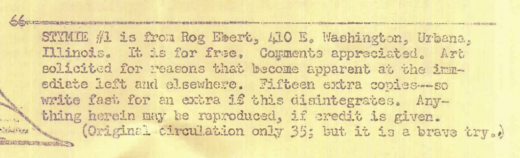
[above: An excerpt from issue #1 of Roger Ebert’s zine Stymie, published in 1960.]
MARK: OK. The internet is pretty great. I’ve found scans of Stymie. (The image above is from issue number one.) It’s so cool to hear Ebert’s voice, as a kid in 1960, talking about going into the basement to mimeograph copies of his zine. And I love the simple description: “It is a brave try.”
DOUG: That’s a major find, and quite a good zine. It’s about much more than science fiction, and Ebert was already an excellent writer at 18 damned years of age.
MARK: A first run of 35 is pretty ambitious too. How many copies of Pathetic Life did you put out the first time, and how did you distribute them? Did you leave them lying around town?
DOUG: You mean, like, freebies? Sir, I’m a cheapskate. I printed twenty copies of the first issue, so I was not as brave as Mr Ebert. Mailed copies to half a dozen to people I knew and zinesters I liked, and put the rest in a box in the closet, hoping someone would want to buy a copy.
MARK: I mentioned earlier that I found a file with some of our old correspondences in it. There’s nothing really worth commenting on. But I was reminded of something interesting. Sometimes, when you’d write to me, to save postage, you’d just open the envelope that I’d sent to you, swap out your zine for mine, and then toss the envelope back in the mail with a “return to sender” type of note scrawled across the front. Here’s an example, which I’ve apparently been holding onto for the past three decades. I remember getting it back in the mail and feeling disappointed, until I opened it and discovered what you had done. I remember being impressed by both your criminality and cheapness.
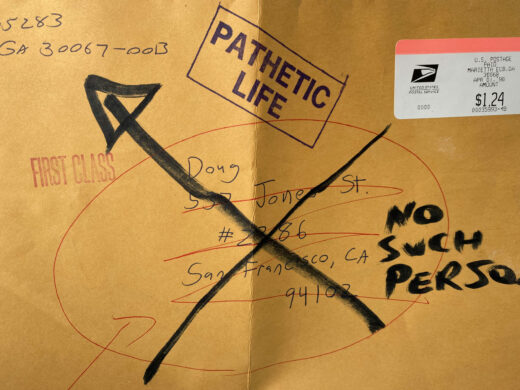
[above: mail sent illegally from Doug “No Such Person” Holland to Mark Maynard in 1996.]
DOUG: You do what you gotta do, and I needed $1.24 more than the Postal Service did. I’m also not troubling my conscience over torrenting old movies instead of giving Netflix a steady income, or circumventing paywalls to read the news. There’s no such thing as ‘stealing’ from giant corporations.
MARK: What was at 537 Jones Street? Was that just a mail drop that you used?
DOUG: Yup. Rough neighborhood then, but it looks nicer now. Continental Mail Box Rentals — they’re still there, right behind the blonde in this Google Street View. Even the sign in the window is the same, thirty years later. It was walking distance from my residential hotel, and there was a cheap but decent omelet and coffee place down the street.
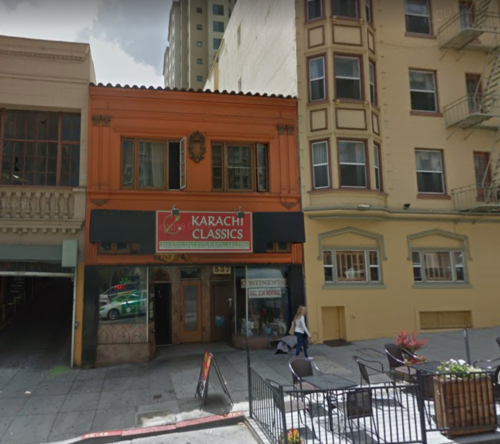
[above: The site of Continental Mail Box Rentals at 537 Jones Street today.]
MARK: Jumping back in time again… What was childhood like for you?
DOUG: Childhood was lonely. I had few friends, felt awkward everywhere, avoided people, and read a lot. Same as adulthood, but without pubic hair.
MARK: You mentioned earlier that you attended kindergarten in New Orleans. Is that where you were born?
DOUG: I was born in Seattle and mostly raised there, but our family lived in New Orleans for several years, and that’s where my earliest memories are. I actually wrote a little about it recently on my site.
MARK: Thanks. I’ll check it out. In the meantime, I want to go back to the “first memory” line of questioning. I promise, I’ll give up on it after this. But I just find it interesting that you said your first memory was of this girl, but that you don’t actually have any memory of her. Is it just the idea of her that you’re remembering, and not a specific moment? I’ve asked a lot of people this question, and I’ve never had anyone respond like this. Usually, when I ask people, it’s a single moment from their life with a lot of sensory stuff attached to it. For me, I was in my crib, happily laying in a pool of warm sunlight, listening to the sounds of kids playing outside, and smelling newly cut grass. I can still see the yellow curtain gently blowing in the warm, summer breeze.
DOUG: Nothing even remotely that sweet comes to mind, sorry. Childhood was unpleasant, so maybe I’ve blocked it from recall. I remember liking a particular stuffed toy, but I don’t remember what it looked like, only that it got mulched by the lawn-mower. I remember skipping school, because days spent skipping were so much better than being educated, but there’s nothing much to tell — I hid in the bushes and read books. I remember being beaten by my father, by teachers, and by other kids in school. Maybe it’s no wonder that I don’t really remember much of my childhood.
MARK: I’m sorry to hear that, Doug. I had no idea that your early life was filled with so much trauma… In the moments that you could escape it — playing hooky in the bushes with your books — what were you reading?
DOUG: Trauma, my ass — everyone has a sob story. Mine is probably *less* sobby than most.
Like Mr Ebert, I was a geek for science fiction novels and short stories, and that’s what I was reading in the bushes. In 3rd or 4th grade, I asked the school librarian if they had any science fiction on the shelves, and she recommended a series of kiddie novels about pigs in outer space — actual oink-oink pigs. I wanted to say no when I saw the dumb picture on the cover, but you know the adage about judging a book, so I read maybe two paragraphs before putting it back on the shelf. Went to the city library instead, to check out sci-fi that wasn’t aimed at children. Harlan Ellison. Ursula K LeGuin. David Gerrold. Bobby Heinlein. All the masters.
MARK: What were your parents like? Were they also lonely and awkward?
DOUG: My parents, as mentioned earlier, were very Christian. They were also politically conservative, but without the overt racism. Dad was a scientist, and Mom was a housewife who, I think, never held a job — she went from high school, to college, to marrying Dad. Of course, everyone is lonely and awkward to some extent, but, near as I could assess, they seemed like relatively normal, well-adjusted people. My siblings were too. I got most of the loneliness and awkwardness in the immediate family.
MARK: Were there any relatives that you felt shared these traits of yours, or were you a new species altogether in your family?
DOUG: There were relatives who were nuts, but their nuttiness was never much like mine. Uncle Alcoholic, Aunt Schizophrenic, Grandma Too-Christian, Nephew Stoner, etc.
MARK: How many siblings did you have growing up?
DOUG: Three brothers, two sisters.
MARK: And I believe some of them were cousins that your family adopted, correct? I should probably look to verify this, but my memory is that your parents took them in from relatives who were struggling, and that much of your life after that as a family was spent dealing with the consequences of that charitable act. For instance, there was a lot of talk, as I remember, of criminal activity, some of which you may have been involved with.
DOUG: Three of my siblings were cousins by blood, yessir. They were the offspring of Uncle Alcoholic and Aunt Schizophrenic, and one of them was seriously malnourished when my parents took him in. The adoptions, though, made them my brothers and sisters — Mom and Dad stressed that (wisely, I think) and it sunk so deeply into me that I was bewildered for a bit when you described them as ‘cousins’. No, man, they’re my brothers and sister.
One of my brothers was a criminal, in youth and adulthood, and yeah, I was very briefly his sidekick, but all is forgiven. He eventually went straight, and then he died, like people tend to do. He was a good soul by the time he croaked, and that’s the best any of us can hope for.

[above: When asked for a photo of himself, this is the image that was provided by the man calling himself Doug Holland.]
MARK: Did anyone in your family ever learn about Pathetic Life? You wrote of your family once, “My family keeps its secrets,” and I’m curious to know how a family like that might have responded to the knowledge that they had a zinester in their midst, sharing stories of their activities.
DOUG: Never yet, and I’d prefer it stay that way.
MARK: So, as you mentioned previously, the name Doug Holland is a pen name. I’m curious as to how you came up with it.
DOUG: Holland is famous for its lax laws on drugs and sex, and in my 20s and 30s I was a libertarian, so it seemed like a natural fit. As for being a libertarian, don’t worry, I recovered.
MARK: So you weren’t storming the Capitol on January 6, covered in poorly taxidermied animal hides, and ranting about how unfair our system is to white males?
DOUG: I wasn’t there, but it didn’t surprise me. They’re mistaken about everything, but yeah, I was one of them when I was young and foolish. Picketed the Post Office on April 15th, had a “Taxation is Theft” bumper sticker, campaigned for Ron Paul for President — oodles of embarrassments.
MARK: What made you change your trajectory in that regard? Was there a specific incident that you can point to?
DOUG: Nothing specific except everything. Libertarian philosophy is a series of shallow guidelines for ignoring reality. Small surprise that, to them, personal freedom trumps wearing a mask while millions of people are dying from an easily-spread infectious disease.
MARK: When did you pack up and leave home, and what were the circumstances?
DOUG: I started packing a week before my 18th birthday, and moved out the morning I turned 18. I wasn’t even a wild kid or anything, got along OK with the folks, but I wanted to come and go as I wished, stop going to church, stay up late, skip showers, walk around naked, smoke a doobie, subscribe to smutty magazines, maybe even bring home a ladyfriend.
MARK: So you dropped out of high school and did what? Did you immediately get on a bus to California?
DOUG: Nah, the move to Cali came years later. I’d been working at McDonald’s, which was of course a wretched hive of scum and villainy, and still is, but I was able to reinvent myself there. They didn’t know I was an outcast at school, so at McDonald’s I wasn’t an outcast. Even odder, to some extent I was respected for doing the job well. They offered me a tiny promotion and a miserly raise. They fed me for free. There were attractive girls my age working there, all friendly, and one was especially friendly. In every way, going to work at McDonald’s was superior to wasting time and risking bodily harm at school. It’s not like I was learning anything in class, and already I was skipping 2-3 days out of every five, so I dropped out, and switched from nights and weekends to the day shift at McD.
Emphatically, 45 years later: No regrets about that.
MARK: So you were still in Seattle, just not under your parents’ roof any longer? Were you writing at all during this time?
DOUG: I wasted years thinking I’d be a novelist, writing chapter after chapter of novel after novel, and it was all dehydrated dog poop, which I eventually shredded.
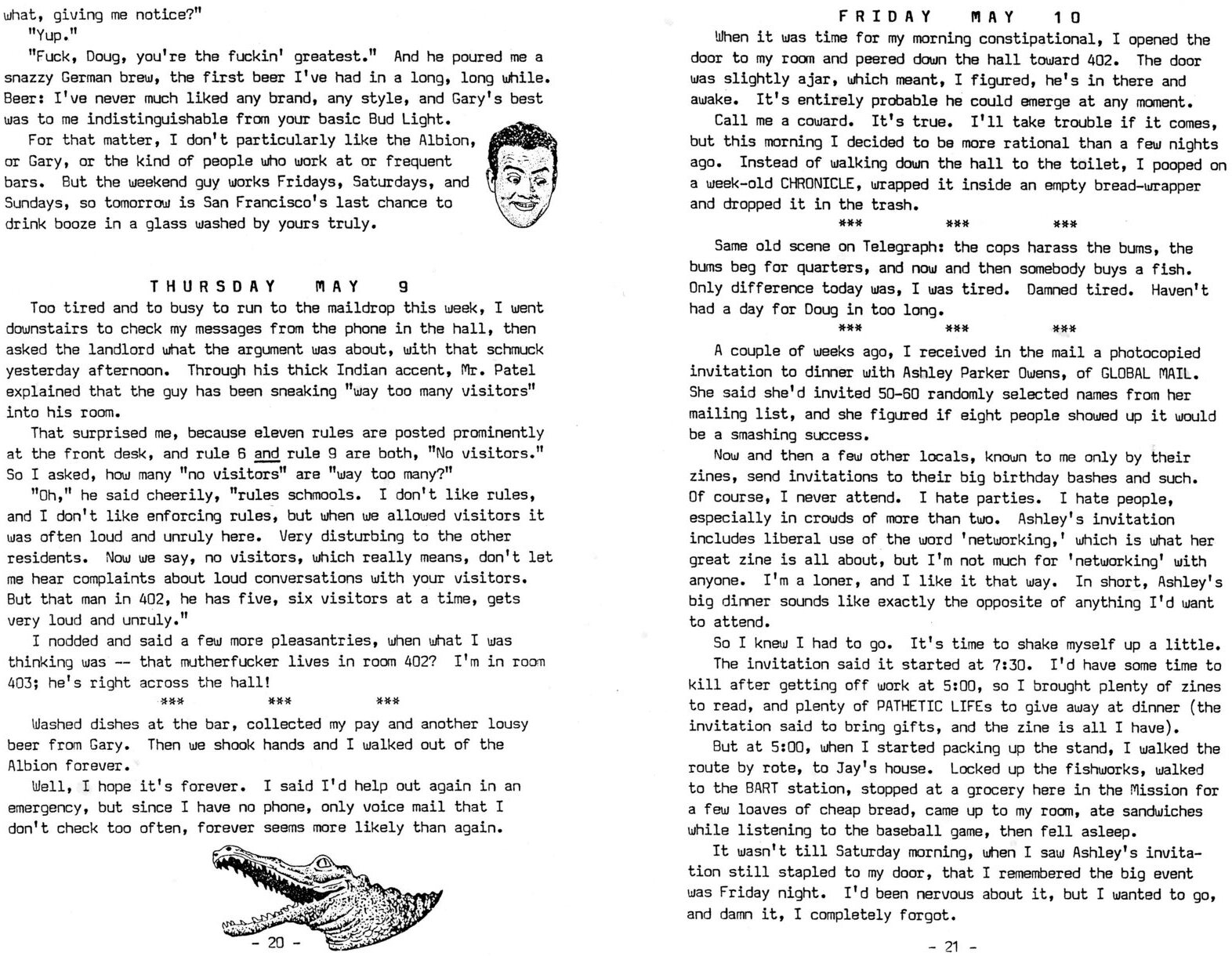
MARK: What are you most proud of, writing-wise? Let’s say I was going to scan a few pages of Pathetic Life, and share them along with this interview — what would you suggest? My first thought was the ass-shaving piece, but I’m open to suggestions?
DOUG: Some site republished the ass-shaving bit, so I’d suggest something different.
“What are you most proud of?” is a question nobody’s asked before, so I had to stop and think. It’s not Pathetic Life; there are some good pages in there, but also plenty of pointless piffle. The best stuff I’ve written are some of the essays on my website. There’s piffle there, too — I leave a trail of it everywhere I go — but there are a handful of pages that I’m pleased with. Maybe “Life advice from a high school dropout,” or “A movie that changed my life.”
Then again, maybe it’s all awful. I’m a lousy judge of my own writing. You can reprint anything you like.
MARK: If you’re up for it, I can include two pieces, to demonstrate your “range”.
DOUG: Haha, I have no range.
MARK: I’ve read the “movie that changed my life” piece, about Harold and Maude. Curiously, I was just talking about the movie a few days ago with a friend at work. We were talking about great movies of the ‘70s that couldn’t be made today. And that was at the top of the list. It’s a brilliant film. Here’s part of what you wrote in your essay about it. I think it ties in pretty well with what we’ve been discussing thus far.
…Harold and Maude and most of the movie’s supporting characters are all sorta screwed up in the head, like I was, when I first saw the movie. And like I am, today. This movie didn’t speak to me, it shouted at me, and what it shouted was, Maybe it’s OK to be strange.
I laughed so hard it hurt (not the cliché but literally) and when it ended I was in tears, of course. I left the theater with a feeling I’d never experienced before, and I’ve never stopped feeling it, ever since: Sure, you’re a little off your rocker, but that’s who you are, so revel in it.
For two lousy dollars, the price of a ticket, I began coming to terms with myself. I wandered home in a daze, my mind reeling. It took a week or two and no drugs were involved, but what followed was a bit of a trip. Lots of staring out the window. Lots of introspection. Nothing earth shattering came from it; just a few low-key realizations:
I am this guy, and he’s not quite normal. If you don’t like it that’s not my problem, but if you can handle it then maybe we can be friends. If you’re a little off kilter too, that’s even better. All this seems so simple saying it now, but back then, for me, this was a revelation…
DOUG: I still watch Harold & Maude at least once a year. It’s even better than most movies about Batman or fast, furious automobiles.
MARK: I found where your “ass shaving” piece had been reprinted. It was on the website for “The Book of Zines,” which came out about 25 years ago. (I can’t believe it was that long ago that we were culturally relevant.) I also read an interview with you, which is posted there. And it’s pretty clear to me that you didn’t want to do it… You really don’t like interviews, do you?
DOUG: Haven’t seen that page in years. Yeah, it does read like they caught me at a peak of my prick cycle.
MARK: Were you ever tempted to gravitate toward fiction during the run of Pathetic Life? Given that you had an interest in being a novelist, and no one really knew who you were, I’m curious if it ever crossed your mind to exaggerate the details of your life in the zine.
DOUG: It was my diary and I stuck close to the facts, but I wasn’t under oath. I embellished a bit. I’d add a wisecrack I hadn’t actually said. Often I fudged the dates — if a whole lot happened on Wednesday and nothing happened on Thursday, half of Wednesday might be moved to Thursday. The extra boring parts got snipped away, leaving only the boring parts, and the names were all changed, of course. It’s 98.5% true.
As for fiction, I’ve written a few short stories. There’s a novel I’m currently stalled with on the website, and I’m working on a new novel that’ll be stalled within a few months.
MARK: If you had a “Rosebud,” like Charles Foster Kane — something from youth that you’d long to have back — what would it be?
DOUG: Hmmm. Can I ‘pass’ like on a game show, think about it and come back to this one later?
MARK: Absolutely… I could probably come up with a better item with time, but the first thing to come to mind is this gold Spiderman medallion that I’d ordered from the back of a comic book when I was about six years old. I remember running to the mailbox every day for what seemed like months, praying that it had finally come. And I remember how happy I was when it finally arrived. It was gold, and heavy, and came on a chain, so that I could wear it around my neck. And the outside edge was reeded, like the edge of a quarter. I guess, somewhere in my subconscious, I think that, if I could just get it back, I’d know true happiness again.
DOUG: Aw, man, I *love* that story and envy that story. Can’t think of anything like it from my mental wayback machine, though.
MARK: Maybe that stuffed animal that got eaten up by the lawnmower.
DOUG: You wanted a happy moment, though. I don’t remember any happy moments with the stuffed whatever it was. All I remember is finding it in pieces on the lawn.
MARK: Oh, I don’t care about happy moments. I just find it interesting to talk with people about their very first memories. It usually leads us in interesting directions. Like now I’m wondering if someone ran over your stuffed animal on purpose, maybe to punish you. I remember visiting a friend once at his house, and he accidentally broke a plate or something in the kitchen. His mom, when she found out, went up to his room, grabbed one of his toys, and snapped it in half. “You break something of mine, I break something of yours,” I remember her saying. It was so fucked up. I’d never seen anything like it.
DOUG: Great story — it’s so splendidly fucked up. A kid’s mom doing that, how can that kid not grow up at least semi-wacko?
I’m pretty sure my stuffed toy’s execution was intentional. Nobody accidentally runs over a foot-long stuffed toy with a lawn mower. And I know my brother did it — it was his chore to mow the lawn. He saw my favorite stuffed toy, and he killed it. Well, there’s a memory.
MARK: Are you presently speaking with anyone in your family?
DOUG: We’re on the best terms since childhood. After twenty years out of touch, now I’m in contact with all of them who are still alive, and it’s all good.
MARK: Do you remember when you first became aware of zine culture, and the fact that people were out there, self-publishing, publicly sharing stories from their lives with the world?
DOUG: I was making zines before I knew other zines existed, and then I discovered other people’s zines in the 1970s (though I never heard the word ‘zine’ until the late ‘80s, or early ‘90s). The real revelation, the “We are not alone” moment, was when I first saw Mike Gunderloy’s Factsheet Five.
MARK: What zines were you reading in the ‘70s?
DOUG: Sniffin’ Glue is the only title that comes to mind. It was punk. I liked some of the music, hated some of it, and never really got into the punk scene or anything. I was never punk, but I liked that zine’s attitude, and the ‘fuck off’ spirit of the better bands. Oh, and Living Free, a libertarian minimalist zine that’s still going.
MARK: What can you tell me about the first zine that you made?
DOUG: When I was a little kid, I typed a neighborhood newspaper which should’ve embarrassed the blood right out of my veins, and then dropped it on people’s porches despite nobody ever asking for it.
As an alleged adult, I created boring political zines in the 1970s and ‘80s, with long gaps between titles. Now I’d disagree vehemently with every word in every issue. Pathetic Life and Zine World are the only zines I’ve published that a few people might remember.
MARK: I’m interested in the neighborhood zine. I know you said before that you were anxious, shy, and kind of a loner as a kid, but this seems like the undertaking of a bright, engaged kid who wanted to connect with people… unless, of course, the zine was just about how much you hated your neighbors and wanted them to leave you alone.
DOUG: Oh, I *wish* I’d done the zine you just described, but mine was much more boring than that. It was called The Daily Blab, though it came out weekly, with great stuff like, the Johnsons are painting their house yellow, the Fords bought a new Chevy, and the Wilkowskis’ lawn is getting tall — did they move out? I never knocked on anyone’s door to ask questions or get the facts; simply walked the block taking notes, and came home and wrote it up. I don’t remember how it got printed (maybe on the mimeograph machine at church?), but I did several issues of that zine, without, of course, knowing it was a zine.
MARK: I love the idea that The Daily Blab didn’t come out daily, but weekly… Was there any response at all?
DOUG: I vaguely recall my parents getting a phone call, telling them to make me stop. Someone must’ve seen me leaving the zine on their porch, because my name was nowhere in it.
MARK: I like the idea of a kid spying on all his neighbors, and printing up a zine about their comings and goings. “I found an empty bottle of diet pills in Mrs. Fisher’s trash yesterday. I guess she’s trying to lose some weight, maybe in hopes of getting her husband back after their big fight last Tuesday night. And it looks from the lawn that the Smiths are out of town again. I wonder if they remembered to lock their back door. It would be terrible if someone stole that new television set of theirs…”
DOUG: “And what exactly was Mrs. Smith doing at Mr. Jones’ house so late on Thursday night?”
MARK: Can you tell me the circumstances surrounding your first exposure to Factsheet Five? Were you still in Seattle, or had you moved to San Francisco by then? Might it have been at Tower Records? I ask because I’m always looking for opportunities to thank Doug Biggert for the work he did at Tower to foster the zine movement.
DOUG: I bought bags of zines at Tower, but my first Factsheet Five came in the mail, not from a shop, and while I was still in Seattle. I’d read a review or a mention of Factsheet Five in Utne Reader, which I’d probably purchased at Tower. Here’s a piece of trivia for you… I very briefly worked at Tower in San Francisco, and it was a great place to work.
MARK: Well, I have another piece of trivia for you. It was Utne Reader that officially pronounced Crimewave dead… I don’t think I got my first issue of Factsheet Five at Tower either, although I did buy zines there. I think I got my first issue through the mail, after reading High Weirdness By Mail. That was what started everything for me.
DOUG: Looks like Utne has pronounced Crimewave alive again? They’ve taken down the page that said Crimewave was dead. Pity. I always enjoy an obituary, if it’s not mine.
Just thinking about High Weirdness led me to an updated High Weirdness, which is itself now outdated, but I still intend to poke around there. I love weird web archaeology, browsing around at abandoned or very obscure sites, anything real and personal that’s survived after Big Business swallowed the entire internet.
MARK: Back to Tower… It was a cool feeling, at least for me, going into the store for the first time and seeing my zine on the shelf. Definitely a milestone. It was right up there with getting the Factsheet Five Editor’s Choice designation, or whatever they called it… What were the biggest milestones in your zine career?
DOUG: Oh, “Publisher’s Choice” from Seth Friedman’s Factsheet Five, definitely. At first I was annoyed and pissed off, because I’d been sending him a copy every month, but Pathetic Life wasn’t listed among the “P”s. When I realized that it was listed up front instead, as a Palme d’Or winner, I stood an inch taller for a few days. After that, so many orders came in the mail, I literally paid my rent with one-dollar bills.
MARK: You mentioned briefly before that your first interaction with Factsheet Five was powerful. Do you remember specifically what you thought that first time you started flipping through the pages of Factsheet Five?
DOUG: Just, holy moly — the thrill of seeing it, flipping through it, marveling at how *huge* it was. I’d always thought there were very few people even remotely like me in the world, and here’s a catalogue listing hundreds of people almost as odd as me. It was similar, I guess, to my reaction when I first got onto the net in the 1990s: How many freaks are out there? As many as there are stars in the heavens.
MARK: What was happening in your life when you decided to put out that first issue of Pathetic Life? Is my memory correct that the first issue started with a mention of your birthday? Were you feeling introspective about growing another year older?
DOUG: Introspective and aging, sure, but you make it sound more serious than it was. I hadn’t written anything in several years, and I wanted to write. That’s all. I’ve always wanted to write, and still do, and maybe one of these days I will. But my life (back then, and now) is astoundingly boring, and I have no imagination. With nothing to write about, I decided to write a zine about having nothing to write about.
It was fun for me, and I was always surprised that a few people were willing to spend three bucks to read it. I’m not sure I would’ve.
MARK: Were there other names that you considered before settling on Pathetic Life?
DOUG: Nope. My girlfriend at the time called my life pathetic when she was yelling at me once, and I knew it was magic the moment she screamed it.
MARK: For a guy with a pathetic life, you always seemed to do pretty well with the ladies. At least I remember references to several girlfriends over the years. To what do you attribute your success with women?
DOUG: Your premise is incorrect, Mark. Luck brought a very few ladyfriends, and then a wife who deserved far better than me, but there were many years when I never saw a boobie that wasn’t on glossy paper. Seven years in a row, and three other years in a row.
MARK: Still, I think you were doing pretty damn well for a self-described “fat slob” who, rather than walk down the hall to the communal bathroom, pissed in his kitchen sink and shit on a newspaper in the corner of his room…
DOUG: I don’t know what to say. I guess I’m the Warren Beatty of zines!
MARK: OK, I found the first issue on your site. Thanks for transcribing it. Here, in part, is how it begins (after the mention of the birthday). And I think it goes a long way toward explaining the zine’s popularity.
“By way of introduction, my name is Doug Holland, and I’m a fat balding old fart with chronic bad breath, precious few friends, barely the funds to hover a week from homelessness, a lot of disgusting habits, a wardrobe that’s utterly unstylish, a routine that’s very very routine, and a job that’s menial and not worth mentioning. So now you know, I’m someone you’re glad you never met, writing a diary you’ll probably wish you weren’t reading.”
It was unlike anything else around at the time. Everyone else in the scene, I think it’s safe to say, was trying to some extent to craft a public version of themselves that was better than they were in real life — more interesting, better looking, etc. That’s not to say that we were all narcissists, but we weren’t talking about our hemorrhoids and canker sores. And I think that brutal, self-effacing honesty resonated with people.
DOUG: Everyone in my family has resonant hemorrhoids.
MARK: Have you thought about getting your mom and siblings together for a new zine, where you talk about this inherited condition of yours (resonant hemorrhoids) over fermented prune juice? I have a name for you to consider — Pathetic Lives.
DOUG: I chuckled, but nah. Nobody else in my family even knows the word ‘zine’.
MARK: I’d like to talk a bit about privacy, and where you drew the line concerning what you felt was OK to share. Your writing in Pathetic Life was very personal. You chose to share a lot, and you did it in a way that no one else was doing it at the time. You didn’t appear to have any boundaries. You laid things bare, and did so with an honesty that really hit people hard. A lot of people were writing about their personal lives, but you took the genre somewhere else. Was that a conscious decision on your part?
DOUG: Well, I wasn’t trying to do anything to a genre, or trying to change anything. It was just words on paper. But, yeah, I wanted to be honest about everything weird and wrong in me. The typewriter as therapist. And also, it wasn’t my top priority but certainly in the top ten, I was hoping to make a few friends via the zine, so I put myself on open display.
MARK: I like “typewriter as therapist.” I also like the description of the zine you gave years ago, in Pathetic Life. You described the zine as “another, less sticky way to masturbate.” In retrospect, do you still see it that way?
DOUG: Masterbatory, sure. Exhibitionism. It was me talking to myself, and for three bucks anyone could eavesdrop.
MARK: Here, for those folks in the audience who might not have seen that first issue of Pathetic Life, is an excerpt from a piece that you’d written about a reunion between yourself and an old girlfriend, who had flown in from Seattle to visit you at the San Francisco residential hotel in which you were living at the time.
…Kissing led to more kissing, which led to squeezing this and rubbing that, and eventually we were in the mood for something special. I rolled the two beds together, and the catastrophe was complete.
To her disappointment and mine, I am now physically incapable of good old fashioned face-to-face sex with a woman — I’m just too damned fat. My belly is so large that it prevents my manhood from reaching her womanhood. It’s basic geometry: the magnitude of my girth means that our special happy places cannot be closer than about seven inches apart.
We attempted several different positions, but with each subsequent failure my erection waned, until finally it all seemed futile, and I was unable to continue trying…
I had this suspicion at first that Pathetic Life was a work of fiction — that you were making all of this up. I just couldn’t wrap my head around the fact that someone would be so fucking honest. I couldn’t accept that what I was reading was real.
DOUG: It was real, man, and what a particularly wonderful moment you’ve selected.
MARK: Would I be right to assume that this particular condition of yours also precluded you from participating at the Black Sheets orgies?
DOUG: Oh, there’s no way I would’ve participated at the parties. I absolutely loved working the check-in table, and walking around making sure people were fucking safely — happy visuals I still replay often — but I’d never boink in front of an audience. Like Seinfeld, I’m not an orgy guy.
MARK: Being so open, though, seems to have had a price. People, as I understand it, started to try to find you. I guess they thought, since you were so open on the page, that they kind of had a right to know you off the page.
DOUG: That’s when I drew the curtain, yeah.
MARK: Do you remember when things changed, and when you realized that maybe you’d unleashed something that might not be altogether positive?
DOUG: It changed gradually, is all I remember. I traded lots of letters with strangers, and met a few people — most of ‘em only once. There were no genuine crazies, though, and the zine brought me some real friends, and a job, and my wife, so I’d say the pros outweighed the cons.
MARK: But there was one instance that made you “draw the curtain”?
DOUG: Someone tracked me down where I worked, because the zine had basically laid out a road map and X marked the spot. It was harmless and innocent, but on the BART ride home it sank into my skull that I’d made myself John Lennon at the Dakota, so that issue of Pathetic Life was The End.
MARK: Can you talk some more about the person who tracked you down at work, and how it played out?
DOUG: It’s funny how the brain works or doesn’t, but I barely remember how it actually happened or who it was. I’d have to re-read my ancient Pathetic Lifes to jog my memory.
MARK: And you immediately decided to pull the plug, based on that one event?
DOUG: That’s my recollection today, yessir.
MARK: It’s this weird line. I think we all probably started zines because we wanted friends who were interested in what we were interested in. Every zine, I think, is like a little “message in a bottle,” cast out into the world in hopes of attracting something positive in return. But, when you do that — when you put something out, into the world — there’s a price to be paid. And you went further than anyone else I knew at the time. In those early issues, you even shared your phone number, and said that you were looking for people to go out and watch old movies with in San Francisco.
DOUG: Jeez, you have done your research. Retyping old issues and posting them online to my website, I was semi-gobsmacked when I saw that page for the first time since the 1990s — “Here’s my phone number. Here’s where I often eat lunch. I’ll be going to this old movie, at this theater, on the 10th of next month.” — and sending that out to strangers, with an invitation for any of them to say hello. The first few times someone said hello, it was nice. Less nice by the dozenth time.
MARK: There’s an interesting kind of a disconnect there. On one hand, you loved and valued your solitude, but, on the other, you were craving human connection of some kind. It’s like you wanted this kind of monastic life, but with friends.
DOUG: I’ve always wanted one or two actual friends. More than that seems metaphysically impossible, but for many years one or two seemed impossible, too. By ‘friend’, I don’t mean someone you share a joke with or talk about football, or the dude who works beside you — I wanted a real friend, damn it. Just one would suffice, and just one at a time is about all I’ve ever had.
MARK: I’m curious as to how much time there was between your drawing the curtain on Pathetic Life and the launch of Zine World, and whether or not one of the bigger motivating factors was your wanting to stay connected to the zine community that you’d come to feel a part of?
DOUG: The years are all a blur, but Pathetic Life had been shuttered for at least months if not years before Zine World was even an idea.
Motivating factors for Zine World? Jeez, I don’t wanna go all Fred Banting here, but Zine World might have been the only thing I ever did that wasn’t about me. It was a huge amount of work I never ‘wanted’ to do, but I did it because it needed to be done. And then, of course, I dropped out of it, like I’ve quit everything in life except my marriage.
MARK: Were people angry with you for leaving Zine World?
DOUG: Jerrianne was probably furious, but she never let on. I don’t remember any complaints about my absence, from Zine World, or anywhere else.
MARK: Had you considered launching any other zines after Zine World? Or maybe the better question is, did you ever put out any other zines, under different names?
DOUG: To me, my website is a zine without paper. Other than that, nope.
MARK: One of the things I really like about your site is that you’re not only transcribing old Pathetic Life pieces, but you’re taking an opportunity to reflect back on what you’d written in the past, and I wanted to share something you wrote recently about a piece you’d written back in 1994 about an interaction that you had with a homeless man.
…I am embarrassed that I wrote the above, and horrified that I said what I said all those years ago, to someone who was wounded already. I disavow all of it. If I knew where that poor, hungry spare-changer was today, I’d apologize to him, and take him to breakfast at the diner.
Every word I wrote is wrong, but I’m posting it anyway, because what happened happened. Honesty was the whole point of my Pathetic Life project. I did this stupid shit, wrote about it, and I guess I even thought it was amusing, so I’m posting it. No fair hiding from myself.
I was me in some ways back then, but politically I was a jackass. Let me tell you why, and what healed me:
When I was young and stupid, I read some books by Ayn Rand, which left me warped. I called myself a libertarian, which is a five-syllable synonym for ass. For too many years I believed, really believed, that wealth is earned, and that most poor people wouldn’t be poor if they just worked harder. That’s where my head was in 1994 — snuggled up deep in my own ass…
It made me really happy to read that. So often, people don’t have an opportunity as adults to change the course that they’re on, or, for that matter, just to reflect objectively on their own existence in this world. I was happy for you that you had the opportunity.
DOUG: I am still a dick, though. I’m just a dick in different ways.
MARK: How are you most a dick these days?
DOUG: By not caring whether you think I’m a dick. Most people waste lots of time, I think, worrying about what people think of them, but I’ve dropped that nasty habit. Sometimes I slip up and accidentally give a damn, but not often.
MARK: Are you finding very much that you’re mortified by, now that you’re going back through old issues, and transcribing them for the site?
DOUG: Just some bad writing.
MARK: In that same addendum I mentioned before, you attributed much of your change in attitude to your wife, Stephanie Webb, who passed away several years ago. “Most of the credit goes to my wife, Stephanie,” you said. “We met a few years after these events, and to say she made me a better man is an exponential understatement; she made me a man, that’s all. With her example, I learned about compassion, kindness, and just generally being a decent human being. Thank you, Steph, forever. And I miss you.” I’m just now getting to know Stepahnie through your writing, and your love for her is clear. It’s actually heartbreaking. And I just wanted to say that I’m sorry for your loss.
DOUG: Well, I do appreciate that, sir. Hell of a woman she was, brilliant and hilarious and the best friend I ever had or ever will. I wish she was beside me right now, and of course … she is.
MARK: Was it the loss of Stephanie that brought you back to writing?
DOUG: In a roundabout way, yes. She was the only interesting thing in my life, and we were always having marvelous big and little adventures together. Without her, I have no interest in adventuring alone. Gotta do something to keep busy, so I write.
MARK: You said you met Stephanie through the zine. Do you mean Pathetic Life, or Zine World — your publication after Pathetic Life?
DOUG: When Factsheet Five shut down, a few friends and I decided to launch Zine World. Tom Hendricks of Musea was one of those friends, and he suggested Stephanie as another reviewer. (Thanks, Tom.) At that point I didn’t know Steph; we ‘met’ when I sent her a short letter asking if she wanted to write for Zine World. I enclosed a Pathetic Life, just by way of introduction. She said yes, and sent her zine, Crawfish, and shortly our letters grew longer.
MARK: How long did you correspond before meeting one another?
DOUG: Not long. We hit it off well on paper, and she came to San Francisco within a few months. We were in love before we met.
MARK: I wasn’t familiar with her zine. What can you tell me about it?
DOUG: Crawfish was comedic, and unlike much comedy it was funny. She wrote lots of short articles, with odd observations about life or pop culture, all causing smiles or laughs. I’d compare it to a good episode of early Saturday Night Live, without the musical acts. And without commercials. I loved it, and loving Stephanie’s zine made me suspect I’d love the lady, too.
MARK: I’m sorry I didn’t have an opportunity to interview her for this series. Had she and I talked about her experience in the world of zines, what would I have likely heard from her? I mean, how do you think she would have summed up her experience as a zine publisher back then?
DOUG: She’d say that her writing was nothing special, but she’d be wrong. Despite being a marvelous human, Steph was always short on self-esteem — and meanwhile, so many of the world’s worst damned bastards believe they’re marvelous.
MARK: Let’s talk about Zine World. A while ago, when interviewing Factsheet Five editor Christopher Becker, I asked about the launch of Zine World and he used the word “animosity.” Did you have animosity toward Factsheet Five, and was that the driving force behind the launch of Zine World? Here’s my exchange with Becker.
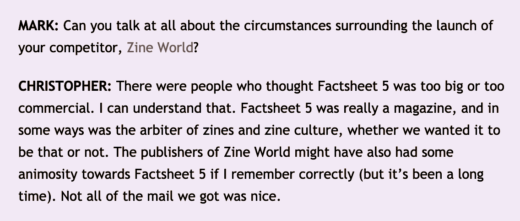
[above: An excerpt from our discussion with Factsheet Five’s Christopher Becker.]
DOUG: It’s a cliché, but I am glad you asked that question, because an apology is owed. There was animosity, but only on my part. I thought Factsheet Five had gone too easy on shitty zines, that except for a few rave reviews, they mostly ‘described’ zines, instead of telling readers whether a zine was any good or complete rubbish. Being a cheapskate (then and now) I’d felt the sting of sending two or three dollars for something that sounded interesting, only to get something that wasn’t interesting at all.
Our mandate at Zine World was different — to write honest reviews. If you sent us something that was a piece of shit, our review would say, “This is a piece of shit.”
From doing our minor-league version of Factsheet Five for a few years, I gained ample respect for what Gunderloy and Luce and Friedman had accomplished. Reading zines for fun is, well, fun, but reading and trying to evaluate hundreds of zines, thousands of zines, is an enormous chore. Seth Friedman and everyone behind Factsheet Five deserves at least a handshake and a beer for what they did. Cripes, without Factsheet Five everything in my life would’ve been different, meaning worse. Much worse. I wouldn’t have made it to the year 2000.
So, my apologies for the animosity, Seth, and thanks.
I’ll send a similar apology to some (but not all) zinesters whose work got awful and unsympathetic reviews in Zine World. Older and 1/3 of a smidgen wiser, I’d say zines, even bad zines, shouldn’t be demolished the same way a critic might eviscerate a bad book or a crappy movie. It’s handmade art and literature, so give ‘em a break — so long as you can see the effort that went into it.
Certainly I’m warmer and fuzzier in writing zine reviews these days, than the old Zine World standard. I won’t perforate anyone’s sphincter over a sloppy layout or too many typos.
I’ll still rip apart a zine that was clearly made with minimal effort, though.
MARK: Had you thought about just taking over Factsheet Five, instead of starting something new altogether? I mean, they were looking for someone to run it, right?
DOUG: I wouldn’t have had the knowhow or even the storage space for running something as big as Factsheet Five. Also, Seth was looking for someone to buy it, not to give it away, and I had twenty bucks on a good day.
MARK: I remember Becker saying that he feared being crushed to death beneath the weight of the zines, both literally and figuratively. Literally, there were so many zines that had to be reviewed, that they were stacked from floor to ceiling, and he was concerned that he might meet his end during an earthquake. Worse that that, though, was the responsibility to get through all of them, and they just kept coming. He said it got to the point where he’d contemplate jumping off the Golden Gate Bridge to escape it. Did you feel any of the same pressure and responsibility at Zine World?
DOUG: At a much lower volume, absolutely. Zine World didn’t have incoming zines to the ceiling, but we had full postal bins stacked in the corner and a few more bins by the kitchen. I dreaded going to pick up the mail, because where would I put it? Was there anyone on staff who didn’t already have dozens of zines we’d sent them to read and review? Who’s going to read these fifty new zines? Yeah, the pressure was relentless, though of course we were tiny compared to Factsheet Five.
I had recurring nightmares about piles of zines to review, and that Zine World was past deadline and should’ve been in the mail a month ago — and 20+ damned years later I had that nightmare again a few months back. I’ll bet Gunderloy is still having similar flashbacks, and that’s why he doesn’t want to talk about it. And thank you again, Jerianne, for taking over Zine World and letting me run screaming into the distance.
MARK: Why did you walk away from Zine World?
DOUG: I wanted a life again. Wanted to come home, drop trou, eat corndogs, and not worry about deadlines and postage and layout and printing and money and the never ending work of it all. I Gunderloyed.
MARK: What were the editorial rules at Zine World, if there were any? Were there things you wouldn’t review?
DOUG: I don’t remember that we had any standards whatsoever, or anything we refused to review.
MARK: Can you walk us through the launch of Zine World, how it came about, and who was involved?
DOUG: I didn’t think the zine world could survive without Factsheet Five or something like it. Seth had announced that he was closing it down, so I asked several zinesters I’d become friends with, and several I knew only from reading their zines, for help in starting a new review zine.
We were Joe Gallo from Gulp Life, Tom Hendricks from Musea, Jerrianne Thompson from A Shattered Mind, Heath Row, Michael Jackman, Jeff Meyer, and of course Stephanie from Crawfish who became my wife. I’m awful with names, especially all these years later, but there were many others who pitched in, too. I might have asked you? I must have asked Kelli Williams (Twenty Bus & That Girl) because I knew her personally and friggin’ loved her zines, but I can’t remember whether she said yes. I am so damned old, sigh.
MARK: I’m curious as to how all the pieces came together. Like what role you played, and what role Bill Brent, the publisher of Black Sheets played? Was it your idea, and did you take it to Brent as a business opportunity? Did you run it out of Black Sheets?
DOUG: Zine World was run out of my residential hotel room, to whatever extent it was run at all. We mailed stacks of incoming zines to our volunteer reviewers, and when their reviews came back — on paper — I typed them into my primitive Brother® brand WP-1400D word processor. At least, that’s what I remember, though others might have helped with the typing. I didn’t have email and wasn’t online, so there was definitely a lot of typing. I’m proud to say, we never got a zine’s address wrong.
Bill at Black Sheets? He was a reviewer for Zine World, but other than handing him a stack of zines to review, he wasn’t involved in the chaos.
Oh, and I’m laughing at the “business opportunity.” I never kept a ledger, but I’m sure Zine World lost money. Quite a lot.
MARK: You mentioned Michael Jackman earlier. I know him. I haven’t seen him in years, but he’s near me, in Detroit. I was doing a small radio show for a while, and he was a guest of mine. I’m not sure where the audio is — I’ll have to find it and give it a listen — but here’s an excerpt from the notes I posted after the fact.
…We talked about Jackman’s travel zine Inspector 18, and the role he played at Zine World, the zine review magazine launched by Pathetic Life publisher Doug Holland in the wake of the announcement that Factsheet Five planned to cease operation. We talked at length about Holland and what we both knew of the man, who, despite his relatively high profile within the world of the underground press, somehow successfully managed to keep his true identity a secret. Jackman and I talked about the possibility of a documentary about the man we knew as Doug Holland, the efforts he took to keep his true identity a secret, and his abrupt disappearance from the world he inhabited. [Jackman joined Zine World in 1996, and took over as the magazine’s news editor in 1997.]…
DOUG: Man, you are an archivist, keeping files on all of us. Wish I remembered Michael better, but to stick out in my memory all these decades later you had to either piss me off or give me a blowjob, and he did neither.
MARK: Was there really talk about a documentary, or did Jackman and I just maybe dream that up ourselves?
DOUG: I have never heard talk of a documentary until you mentioned it. There are maybe half a dozen people who’d be interested in it, and I’m not one of them. Please, don’t do it.
I’ve read many books by B Traven, best known for Treasure of the Sierra Madre. Some of his novels are terrific, still among my favorites, and of course the Humphrey Bogart movie of Treasure cannot be improved upon. The author always eschewed publicity and never said much of anything that was truthful about his personal life, but B Traven was known or believed to be a non de plume. Weirdly, what seems to fascinate many people isn’t his books, it’s trying to figure out who he ‘really’ was. There are multiple theories, and even books that purportedly reveal his ‘actual’ name and life story.
I don’t share that fascination. Dude’s been dead for fifty years, but still, respect his privacy. He went by B Traven, so B Traven is who he was. End of story. I’m no B Traven, but I feel the same.
MARK: I’ve never read the book, but Treasure of the Sierra Madre is one of my favorite films. (You and I share a love for old film.) And don’t worry about me making a documentary. I lack the money, time and motivation. I do think your story is pretty fascinating, though. People like mysteries… you, B Traven, Banksy, DB Cooper, Shakespeare, the killer of the Black Dahlia… The list goes on. Come to think of it, you’re not even the only mystery man in the world of zines. We also had Kool Man. Did you follow that case?
DOUG: I had to google it to remind myself of the Kool Man saga. That was some ugly shit, and nope, I never much followed it.
Also, read the book — Treasure of the Sierra Madre is a great story, terrifically told.
MARK: Any regrets about Pathetic Life — things you wish you’d done differently?
DOUG: Well, I turned down a book deal — twice — but I’m not sure I regret that. It’s more a wistful memory, ‘path not taken’ and all that. Just think, I could’ve been a forgotten author, instead of merely a forgotten zinester.
MARK: Just curious if the book deals came immediately after that New York Times story in 1995 — “Now, the Magazines of ‘Me’.”
DOUG: It might have had more to do with being a Factsheet Five “Publisher’s Choice.” That’s when the NY Times and Interview and other big-timers started calling.
The NY Times article was frustrating. I’d been hesitant to talk to them, but when we spoke I told their reporter *repeatedly* that zines only exist by mail, so the article *must* include contact info and mailing addresses. He said he understood, and promised that they’d include contact info for every zine that was mentioned, and of course, they didn’t. With no addresses and no Google back then, the article amounted to, “There are these cool publications called zines. You can’t read them. Bye.”
MARK: You mentioned to me earlier that you’ve never liked doing interviews, and have only done a handful in your life. I hope, so far, this has been a pleasant experience.
DOUG: I wasted an hour of my life talking to that guy from the New York Times. He lied to me, and also didn’t use a word that I’d said. You’re his opposite. I’m impressed by how you’ve gone about this. You’re Barbara Walters, man. I wouldn’t have done this for anyone but you.
MARK: Why’d you turn down the book deals? Were you afraid that your identity would be revealed, or were there other considerations?
DOUG: I wanted to be a writer, not necessarily an “author.” I like zines, and wanted to publish my zine, my way. A publisher would tell me certain entries were too salacious or blasphemous, and what’s with all the movie reviews? They’d replace Jeff Meyer’s marvelous cover art, and maybe they’d send me to talk to the morning zoo crew on the radio in Cleveland, and then Cincinnati, and then Columbus — and I would hate all of it. Take something I loved, and make it something I’d abhor? No.
And a book of Pathetic Life would’ve flopped, anyway.
MARK: But I’m assuming that they were offering money, right?
DOUG: There are more important things, and anyway, the conversation didn’t get that far. They said, “We would like to discuss the possibility…” but I could tell from their letters that I’d despise those people.
MARK: I’m trying to get a sense of the timeline. You said that you were working at the job that gave you free access to the printer, until about issue #10. And that’s when you started the whole “I’ll do anything for $5 an hour.” I’m wondering if that’s also around the same time that the New York Times piece came out, in May of 1995. If so, that seems like a huge inflection point in the timeline of Pathetic Life. There was a lot of shit happening really fast.
DOUG: You’re probably right, but I’m not much help with the timeline, sorry. I was out of work and on edge, hoping the freelance do-anything gigs would be enough to pay the rent. If other things were whirling fast at the same time, guess I didn’t much notice.
MARK: What were you doing at Macy’s, where you were working until around issue #10? And why did you end up leaving?
DOUG: Same work I’ve done almost all of my adult life — office work — but Macy’s made it awful. I’ve never worked for a company more determined to go out of business, and I’m surprised they’re still swirling instead of already down the drain.
I quit because fuck it. I’d moved a thousand miles to get away from Seattle and live my life my way, but I’d ended up with essentially the same job — office drone again — in an office worse than the one I’d left behind. There came a morning when I didn’t want to go into that place, so I didn’t.
MARK: Was there anything that you wouldn’t write about in Pathetic Life, short of things that might reveal your identity, or alert members of your family to the publication?
DOUG: Yes, and of course. Someone who doesn’t have any secrets has *really* led a pathetic life.
MARK: I kind of like thinking about these zine interviews of mine like a game of tag. Let’s say, now that I’m interviewing you, you get to choose who I speak with next for this series. Who do you pick? What zine personality from “the golden era of zines” would you like for me to talk with next?
DOUG: Joe Gallo is a friend, and a fat bubbling cauldron full of great stories. Kelli Williams, who’s Kelli Callis now, is one of the greatest writers I’ve ever read. Jerianne Thompson, who ran Zine World for years after I’d left. Sarah-Katherine of Pasty, who brightened my life and scored a book deal. The lovely and talented Jeffrey Meyer. Mike Gunderloy, of course, and Seth Friedman. Hell, even Hudson Luce. Fred Woodworth at The Match, though he’d cringe if you called The Match a zine, and of course, you couldn’t interview Fred via the web, as he’s resolutely webless. Some of my other favorites would be unknown to you, or to most people, even people active in zines back then.
MARK: So, let’s say I tracked down Joe Gallo, what would you suggest that I ask them?
DOUG: I’m confident he’s a him, though I’ve never checked. You could ask Joe the same questions you’re asking me, I guess. His zine wasn’t as popular as mine, but his writing was at least as good, often better. The main difference was, he wouldn’t write unless he had a story to tell, but that’s never stopped me.
OK, wait — now it belatedly occurs to me, if you never saw Joe’s Gulp Life you’d be without a starting point for asking questions. I’d revise my answer, then, and say, any zinester I’ve mentioned that you remember reading. And also, of course, Gunderloy and Friedman, if they can be found. I would gobble up an interview with either of them — they saw the whole era.
MARK: I haven’t reached out to Friedman yet. I did write to Gunderloy, though. His response, when I asked if he’d be willing to chat about the start of Factsheet Five, was polite, but terse. “Sorry, that was decades ago,” he wrote to me. “I’ve said everything I care to about zines.” I think his story is important, and I’d love to share it, but I don’t intend to go any further with him. I’m here, though, if he ever changes his mind. Others whom I’ve talked with for this series also said no to me at first, only to come back around later, saying they’d be up for it. I respect Gunderloy’s decision, but obviously hope that he’ll change his mind. As for Gallo, I did read Gulp Life, but not religiously. And I’d be happy to talk with him, if you’d like to make the introduction.
DOUG: Reckon we gotta respect Dr. Gunderloy’s decision. I’ll nudge Joe, if he’s nudgeable.
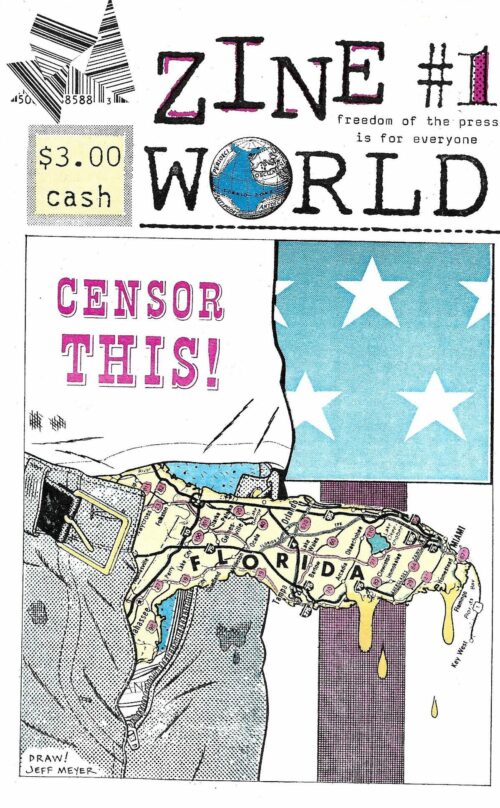
[above: The cover of Zine World’s eleventh issue. Artwork by Jeff Meyer.]
MARK: As we were discussing Dishwasher Pete earlier, I reached out to him last night to say hello. And I mentioned that you and I were doing an interview. He wrote back, and we got into a discussion about the story arc of Pathetic Life. Here, in part, with his permission, is what it wrote. It ends with a question for you.
…I loved Pathetic Life and I loved how Doug wrote about his time in the hotel, in the Tenderloin, eating at cheap restaurants, going to the movies, working low-wage jobs, etc. At the same time, I recall wanting him to move out of that place and somehow live a less pathetic, “happier” life. (I don’t know how to describe that better). And then he indeed seemed to take steps to live a happier life. His creating and distributing Pathetic Life seemed to have brought him into contact not just with me but with probably hundreds of others who would become fans if not friends. This connection with others seemed to help lift up Doug. His life seemed to shift. He started doing Zine World and seemed to have more focus and passion and drive in his life.
On the one hand, I was happy for him. Yet, on the other hand–and I feel guilty stating this–I missed reading about the pathetic life of Doug. There was something quite genuine and raw and real about Doug in those first issues of PL that I found quite interesting and curious and powerful. And somehow maybe that got lost with him finding his place in a community and more of a purpose and drive in life. (Now, after typing that, I imagine others who could easily have that opinion about me and Dishwasher.)
I don’t know quite what the question is that I want you to pose to Doug. I suppose it’s something like: How did life change for you when you found / created a community for yourself in the (small caps) zine world? Do you judge you lost something when you became a minor celebrity in zine circles? By documenting your “pathetic” life, do you judge your life became less “pathetic”?
DOUG: First, give Pete a sloppy french kiss and an inappropriate assgrab from me.
It’s an interesting question, and something I’ve maybe never thought about until now. I always wanted to write, which carried the implied question, “But do I have anything to write that’s worth reading?” With the (small, zine-scale) success of Pathetic Life, I came to understand that, yeah, my writing does connect with some people. It made me believe I *am* a writer, not just a guy who wishes he was.
Many marvelous and many horrible things have happened since, but life was never again as pathetic as when I started the zine. Pathetic Life made me happier, less pathetic. Maybe being happier ruined me — I certainly haven’t written anything else that connected with people like Pathetic Life did. That last line is a joke. Mostly.
MARK: Doug, I’m at a disadvantage, as I can’t find my old copies of Pathetic Life, but — speaking of things getting better for you as you started making friends and the like — am I remembering correctly that, by the end of Pathetic Life, you had a roommate (and a pet cockroach)?
DOUG: Along the zine’s two-year run, I briefly lived with a couple of roommates in a San Francisco slum, and longer with a sweet lady and her husband in Berkeley. There were also a couple of pet cockroaches, but they didn’t last long. The roomies and roaches never overlapped each other, though.
MARK: Let’s talk about the pet roaches. Did you have a favorite?
DOUG: Nah, I hate cockroaches, but they’re my favorite among the infestations I’ve endured, greatly preferable to bedbugs, mice, rats, fleas, hundreds of flies, or recurring jock itch. Of all these, only roaches become entertainment, squishing them one by one as they appear.
My first ‘pet’ roach happened to climb into a cassette tape box, which I snapped shut, and then I fed it and became reluctant to kill it. Someone mailed a second roach to me, alive. I should remember who sent it, but at the moment I don’t.
MARK: Did you have the roaches for long?
DOUG: Not long at all, but I don’t remember their demise. I *might* have gone all soft and sentimental and gifted them to someone, but most likely I crunched ’em.
MARK: Have you ever considered how things might have turned out differently for you if you hadn’t started Pathetic Life?
DOUG: Yeah, I look back in amazement. Everything in my life would’ve been different — and so much worse — if I’d waited for the “Walk” sign instead of looking both ways and darting across the street. If I hadn’t given away almost everything and run to California… if I hadn’t gotten bored and decided to start a zine of my Pathetic Life… if I hadn’t found co-conspirators to create Zine World… then I never would’ve met Stephanie, we never would’ve have had 20+ years of actual human happiness together… and I’m completely certain I would’ve been dead long ago from a bullet through the brain.
Jaywalk often, kids. There’s a wonderful world on the other side of the street.
MARK: So, would you go so far as to say that the zine saved your life?
DOUG: Stephanie saved my life, but without the zine I’d never have met Stephanie, so — yes, definitely.
MARK: One last thing. What’s the most interesting question you’ve ever been asked?
DOUG: Maybe that one. There are a billion interesting questions, from “What’s the meaning of life?” to “Would you mind if I took off my blouse?”, but with only rare exceptions, I prefer a comfortable silence. Or simply solitude.
MARK: Well, thank you for coming out of your dickish armor long enough to talk. I really appreciate it, Doug. And wish you all the luck in the world with your novel. I hope you publish under the name Doug Holland so that I can find it.
DOUG: If there’s ever a novel it’ll be self-published, I’ll still be Doug, and I’ll drop you a note. Thanks for still being Mark, and for letting me join your “Old Farts of Zinedom” collection.
[If you should find yourself still wanting more, Doug has started transcribing Pathetic Life stories on his new website, ItsDougHolland.com. He’s also been kind enough scan a Pathetic Life story about the time he spent working at a San Francisco tavern called Albion (part one, part two, part three). Oh, and if you haven’t already, check out the other interviews in the Untold History of Zines series.]